How to grip and release a gyroball | Henken [Baseball Pitching Lab Japan]
Gyroball
A gyroball is a pitch in which the axis of rotation aligns with the direction of travel.
In other words, it is a ball with a spiral (gyro) spin.
A familiar example from another sport would be a spiral pass in rugby.
The specific rotation is as shown in Figure 1 from the pitcher’s or catcher’s perspective (the diagram shows clockwise rotation, but counterclockwise is also possible).
Because the seams do not visibly rotate relative to the direction of travel, a gyroball can either reduce air resistance compared to a fastball (four-seam or two-seam) or increase it depending on seam orientation (one-seam).
Another key characteristic of a gyro spin is its strong straight-line trajectory, as long as the rotational axis remains stable.
However, it is difficult to throw a perfectly pure gyro spin with a baseball.
In practice, slight deviations in the axis—such as slider-like or screwball-like spin—will cause the pitch to break in the corresponding direction.
Types and Trajectories of Gyroballs
Gyroballs can be broadly classified into two categories: those that utilize seam-induced air resistance (four-seam, two-seam, and one-seam gyroballs), and those that emphasize the straight trajectory of gyro spin, such as the gyro fork.
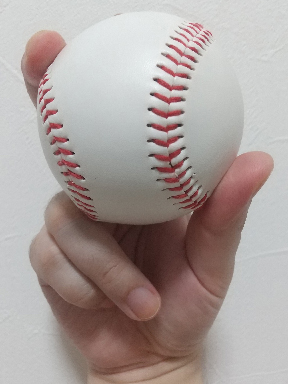
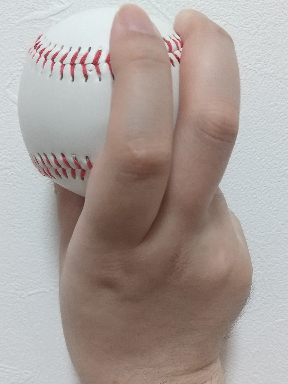
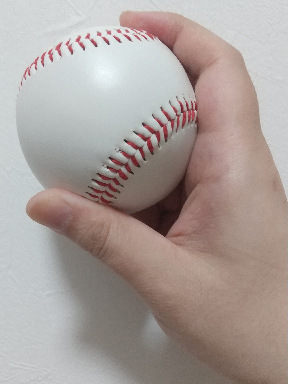
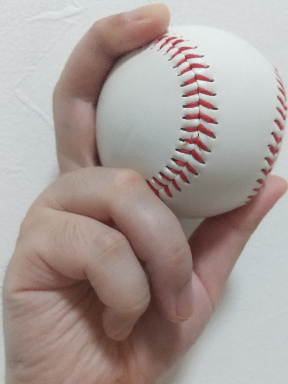
A four-seam gyroball spins as shown in Figure 2, while a two-seam gyroball follows the seam orientation shown in Figure 3.
A pure four-seam gyroball experiences less air resistance than a standard fastball, making it one of the pitches that loses velocity the least.
A two-seam gyroball has slightly more air resistance than a four-seam gyroball, making it closer to a standard fastball in terms of deceleration.
Unlike a fastball, a gyroball does not generate upward lift from the Magnus effect, so it drops naturally due to gravity.
As a result, a four-seam gyroball behaves like a “rising” yet sinking pitch—it maintains velocity while dropping more than a fastball.
A two-seam gyroball, due to slightly greater deceleration, drops even more than a four-seam gyroball.
While a forkball achieves a large drop by increasing air resistance and slowing down significantly, a gyroball achieves its drop by minimizing air resistance and maintaining speed. This gives it a fundamentally different profile among breaking pitches.
Comparison with Similar Pitch Types
A simplified comparison between gyroballs and similar pitch types:
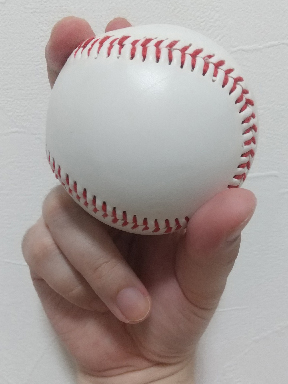
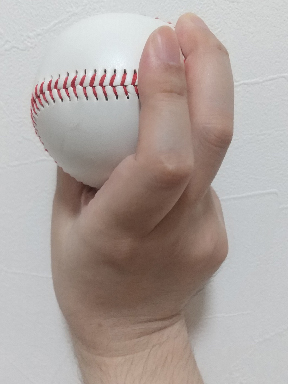
The four-seam gyroball is gripped similarly to a fastball, but with the ball slightly rotated to the left.
The index and middle fingers are placed together across the seams.
For the release, keep the pinky-side edge of the wrist facing directly toward the catcher as you deliver the pitch.
At release, use the fingers on the seams to apply a vertical “cutting” motion to the ball.
The cleaner the gyro spin, the lower the air resistance and the less horizontal movement the pitch will have.
Grip and Release of the Two-Seam Gyroball
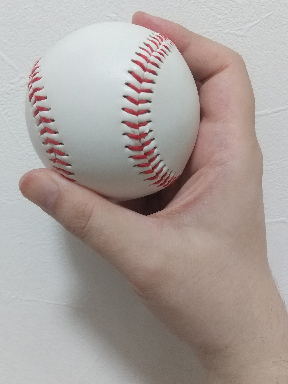
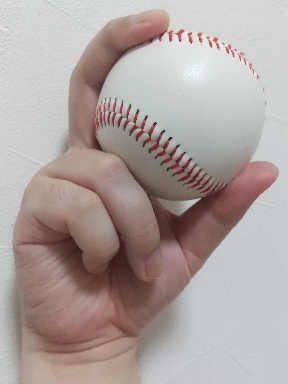
The two-seam gyroball is gripped by placing the fingertips of the index and middle fingers along the narrow seam orientation.
The arm action and release are the same as for the four-seam gyroball.
Keep the pinky-side edge of the wrist facing directly toward the catcher as you deliver the pitch.
At release, use the fingers on the seams to apply a vertical “cutting” motion to the ball.
The cleaner the gyro spin, the lower the air resistance and the less horizontal movement the pitch will have.